Signal Conditioner
For resistance
or PRT inputs |
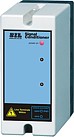
Converts inputs from resistance transducers e.g. variable resistances, potentiometers, resistance temperature detectors (RTD), platinum resistance thermometers (PRT), into standard voltage or current process signals. Input and output are not isolated from each other. |
 |
| |
Type |
B12-1 |
| |
 Signal conditioner data sheet Signal conditioner data sheet
|
| |
 Signal conditioner user guide Signal conditioner user guide
|
|
|
Set Point
Generators
Also see
C16-65>
|
Provide a
current or voltage output, the magnitude of which is controlled either by:
• a front panel mounted control (adjustable type).
• a remote
set-point with the set-point potentiometer and dial supplied loose for remote
mounting e.g. in a control panel or enclosure door or
• a fixed output
which is internally set to the level required. |
 |
| |
Adjustable |
B12-1A |
| |
Remote set-point |
B12-1RP |
| |
Fixed set point |
B12-1F |
| |
Set-point generator data sheet
|
|
| |
Set-point generator user guide |
|

|
|
Millivolt Signal Conditioner /Bridge Amplifier
|
Accepts
voltage signals from bridge type transducers (e.g. load
cells) and other millivolt sources in the range 0-10mV to 0-100mV. The gain is user selectable. Optionally the unit can be calibrated for
voltages from 0-1V to 0-10V. An isolated and stabilised transducer power supply
is provided. |
 |
| |
Type |
B12-1B |
| |
Bridge amplifier data sheet |
| |
Bridge amplifier user guide |
|
|
Loop-powered Trip Amplifier |
The B12-2W single point trip amplifier provides voltage free contacts which change state when the input signal passes an adjustable reference set-point. No auxiliary supply is required as the trip amp derives all its power from the 4-20mA signal being monitored.
|
 |
| |
Type |
B12-2W |
| |
Trip Amp data sheet |
| |
Trip Amp user guide |
|
|
Isolating Signal Conditioner
|
Designed to cater for the more demanding applications such as non-standard input and output signals, inverting, bidirectional and reverse acting signal conversions. Outputs are user configurable. Accessible span and zero adjustment, Wall or DIN rail mounting. |
|
| |
Type |
B12-3 |
| |
Signal conditioner data sheet |
| |
Signal conditioner user guide |
| |
|
|
|
Analogue to Frequency Converter
|
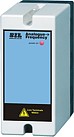
Converts a DC voltage or
current (mA) input signal into pulses with respect to time. The output pulse rate is
proportional to the magnitude of the input signal. Provides continuous integration of any analogue process signal varying with time ('rate' signal) e.g. flow, BTU, Watts. etc. |
 |
| |
Type |
B12-5 |
| |
Analogue to frequency converter data sheet(pdf) |
| |
Analogue to frequency user guide (pdf) |
|
|
Analogue Summator |
Sums / subtracts up to three voltage or current input signals. The
output signal may be current or voltage and will be proportional to the sum or
difference of the input signals. This unit will perform an averaging function
with equal input ranges. See 112-6A for number of inputs greater than three. |
 |
| |
2 Input Version |
B12-6/2 |
| |
3 Input Version |
B12-6/3 |
| |
Summator / subtractor data sheet |
| |
Summator / subtractor user guide |
|
|
|
Root
Extractor
Square root
3/2 Law
5/2 Law
|
Provides a voltage or
current signal output which is proportional to one of the following
functions:
• Square root of the input signal (e.g. for DP
transmitter)
• 3/2 law (e.g. for flowrate measurements from flume or
weir)
• 5/2 law (e.g. for flowrate measurements form 'V' Notch
weir)
Input and output signals may be current or voltage and the unit will
convert to signals of different ranges and types. The unit provides an optional
transducer excitation supply. |
 |
| |
Root Extractor |
B12-7/1 |
| |
3/2 Law |
B12-7/2 |
| |
5/2 Law |
B12-7/3 |
|
| |
Root extractor data sheet |
|
| |
Root extractor user guide |
|
|
|
Frequency
to Analogue
Converter
Also see
C16-10>
|
Provides a mA or voltage output proportional to the frequency of the input signal. The B12-10C has many uses in applications including water and energy metering and rotational measurements.
Optional PC configuration software provides range changing and optimisation of digital filtering to suit site conditions.
- Frequency ranges from 0 - 0.1Hz up to 0 - 5kHz
- Programmable filtering and ranging via
USB infrared link
- Transducer power supply
- User selectable inputs: open-collector, volt-free contact, current pulse (e.g. NAMUR 1-3mA pulse), and voltage pulse (10 mV p.t.p. to 250 V R.M.S - sine, square or
triangular waveforms)
- User configurable output ranges: V, mA sink or source
- Wall or DIN rail mounting
|
 |
| |
Standard unit - see data sheet |
B12-10C |
| |
Pre-configured to order |
B12-10C/9 |
| |
Programming Kit |
Prog-10U |
| |
Frequency to analogue data sheet |
| |
Frequency to analogue installation guide
Frequency to Analogue programming guide |
| |
 download
configuration software download
configuration software
|
|
|
|
Multiplier |
Provides an analogue
output signal proportional to the multiplication of two analogue input signals.
The input signals may be of differing types e.g. current / voltage, true /
raised zero, etc.
NB The multiplier can also be made to function as a
squarer. |
 |
| |
Type |
B12-12 |
| |
Multiplier data sheet |
| |
Multiplier user guide |
|
|
Rate Limiter |
A range of
signal conditioners providing functions which control the rate of change in the output
signal for a change in input signal. These units may also provide signal
conversion. The time constant is adjustable by a front panel mounted dial.
Times to FSD are calibrated to order and are typically available from 0-60s up
to 0-120s. |
 |
| |
Rate limiter data sheet (for all versions) |
| |
Rate limiter user guide (for all versions) |
| |
|
| |
Slow Up Fast Down
Response Unit: the response curve is an exponential and the time to steady
state output is the same for any magnitude of change of a rising input signal.
However for a negative going change in input signal, the output response is
virtually instant. |
| |
Type |
B12-17/0 |
| |
|
|
| |
Rate Limiter:
the response curve is linear giving a ramp with a fixed rate of change. The
effect on the output is a response time proportional to the magnitude of the
input signal change. |
| |
Type |
B12-17/1 |
|
 |
 |
 |
|
| |
Slow up, Slow Down
Response Unit: the reponse curve is similar to the B12-17 /0 but the rate
of change is also controlled for negative going input signals |
|
|
| |
Type |
B12-17/2 |
|
|
|
Rate of Change
Monitor |
Provides an output signal, with magnitude proportional to the rate of change of the input signal. |
|
| |
Type |
B12-18 |
| |
Rate of change monitor data sheet
|
| |
Rate of change monitor user guide |
| |
| |
|
 |
|
Signal Isolator /
Signal Splitter
Also see
C16-3> Signal Splitter
|
- Provides isolated signal repeater, signal conversion or signal splitter functions
- Operates from either AC or DC supplies
- User configurable input and output.
|
 |
|
Single Output |
B12-Si2 |
|
Dual Output |
B12-Di2 |
|
signal isolator data
sheet |
signal isolator user guide |
|
|
|
|
Trip
Amplifiers
|
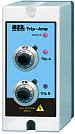
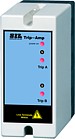
Provides voltage free contacts which change state when the input
signal passes an adjustable reference point. Single and dual point versions are
available. A single pole change-over relay contact is provided for each set
point. The dual version offers interlocked channel operation. Basic models
provide low-cost options with set-point adjustment by multi-turn trim controls
accessed through the front panel.
|
  |
| |
Single Point |
B12-ST2 |
| |
Single Point with 10-turn
dial |
B12-ST2/K |
| |
Dual Point |
B12-DT2 |
| |
Dual Point with 10-turn
dials |
B12-DT2/K |
| |
single / dual trip amplifier data sheet
|
|
| |
single / dual trip amplifier user guide |
|
|
|
|
Programmable Triple Trip
Amplifier |
The B12 three-point
trip amplifier specification includes: universal mains power (85 to 265 VAC) or
optional 24VDC (18-36VDC), Three set-points, Four digit
display of monitored variable Programmable,
trip points, input source and scale, delay, hysteresis, relay action, alarm
type Monitored channel status indication Scaling
0-100%, voltage, mA or custom engineering units
Simple to use yet
powerful menu-driven software enables fast flexible set-up from the front
panel. No adjustment of internal potentiometers, internal links or plug-in
cards is necessary. This versatile unit lends itself to numerous applications
including detection of high/low alarm conditions and pump control.
|

These functions are also available in the 500-TT Process Display  More details here |
| |
Type |
B12-TT |
| |
triple trip amplifier data sheet
|
| |
triple trip amplifier user guide |
|
|
|
Signal
Isolator
(Field
configurable ) |
Provides
cost-effective signal isolator, booster or signal converter functions, with the following features:
• Total isolation for 2 & 3 wire
transmitters
• Field programmable input & output ranges
•
24 V transmitter / loop supply
• Universal 85-260 VAC powered.
The input, outputs
and power supply are electrically isolated from each other making these units
ideal for preventing or solving erratic measurements due to earth loops. |
 |
| |
Type |
B12-Txi |
| |
field configurable signal isolator data
sheet |
| |
field configurable signal isolator user guide |









